
China on Thursday announced that it would radically reform its gross domestic product calculation methodology and statistics release, to make it at par with international standards.
The first-quarter growth exceeded market estimates of 7.3 per cent, China's National Bureau of Statistics said on Wednesday.
The Gini coefficient, which reflects the wealth gap between rich and poor, was at 0.474 level for China in 2012 -- well above the warning levels, a report has said.
China's demographic problem due to ageing population is showing up as the labour force for first time has decreased by 3.45 million last year, prompting officials to appeal to the new leadership to devise "appropriate and scientific" population policy.

The Chinese economy grew by stunning 10.7 per cent in the fourth quarter of 2009, which may see it replacing Japan as the second largest economy in the world.
China's economy will maintain its rapid growth next year though the government may face greater difficulties in macro-economic control, a top official of the National Bureau of Statistics said.
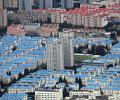
China's real estate investment rose 20.2 per cent in the first quarter from the same period a year earlier.

China's population in 2022 -- 1.4118 billion -- fell by 850,000 from 2021, the National Bureau of Statistics (NBS) said.
Over 23 million people were brought above the poverty line in China last year as about 100 million people from rural areas moved to cities for work.

China grew by 9.7 per cent in the first quarter of this calendar year while inflation sped to its 32-month high of 5.4 per cent, according to the data released by National Bureau of Statistics (NBS).
The Chinese economy grew at its slowest pace in 13 years posting 7.8 per cent year-on-year growth in 2012 amid external jitters and domestic woes.

It was higher than 3.2 per cent rate registered in February, the lowest pace recorded in 20 months, state run Xinhua reported.

Profits of major industrial firms slipped 5.4 per cent year-on-year to 366.8 billion yuan (about $59 billion) in July, the National Bureau of Statistics said in a statement.
China's gross domestic product soared to 13.65 trillion yuan ($1.65 trillion in 2004, an impressive growth of 9.5 per cent year on year, the government said in Beijing on Tuesday.

The Chinese government has vowed to fine-tune the economy which continued on the declining trend, registering 8.1 per cent GDP growth in January-March this year, the lowest quarterly rise in nearly three years.
An economic superpower, China is marching ahead to become the world's largest economy.
Hit hard by a sharp drop in its trade surplus due to decreasing exports and rising inflation, China's GDP growth rate slowed to 9.1 per cent in the third quarter, the lowest since the fourth quarter of 2010, sparking concerns about a possible hard landing of its economy.

To curb soaring inflation, the People's Bank of China, the country's central bank, has raised the benchmark interest rate three times this year.
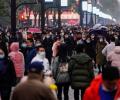
The population is important and so is the talent, he said about China, the world's second-largest economy after the United States.
China's economic growth slowed down to 7.4 per cent year-on-year in the third quarter of 2012, slower from 7.6 percent in the second quarter and 8.1 percent in the first, the National Bureau of Statistics (NBS) said.

According to the list of business uploaded on the apex court website, the plea of opposition parties would be heard on April 5 by a three-judge bench headed by Chief Justice of India D Y Chandrachud.

Industrial profit in China rose to 55 per cent in the first eight months of this year, according to new official figures released by the Chinese National Bureau of Statistics (NBS).
China's economic growth fell to 7.6 per cent year-on-year in the second quarter of 2012, from 8.1 percent in the first quarter, the slowest growth since first quarter of 2009.
China's average GDP growth rate for the 1979-2004 period was on Monday revised to an impressive 9.6 per cent, 0.2 percentage point higher than the original figure in accordance with the first national economic survey.

The Chinese economy recorded a stellar growth of 11.9 per cent in the first three months of 2010, marginally higher than projected.
China's economy slowed down amid inflation concerns as its GDP growth rate slid to 9.5 per cent in the second quarter from 9.7 per cent in the first, while the economy in general expanded by 9.6 per cent in the first half of this year.
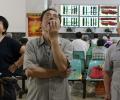
The manufacturing and construction sector accounted for 42.7 per cent of GDP while the farm sector accounted for 9.2 per cent.

The Supreme Court has dismissed a PIL seeking declaration of all animals as legal entities having rights like any living person.

Prospects of China hiking interest rates increased as inflation rose to 3.1 per cent in May, surpassing the government target of 3 per cent.

China's economy grew by 8.1 per cent in 2021 to about $18 trillion despite challenges, including epidemic resurgences and a complicated external environment, the government said on Monday. According to the official figures released by the National Bureau of Statistics (NBS), China's economy grew by four per cent in the fourth quarter of last year, slowing from the 4.9 per cent growth in the third quarter, rounding off the full year's growth rate to 8.1 per cent in 2021. The GDP increase is also above the six per cent target set by the government for the year.
China's inflation rate rose to 8.5 per cent in April, bouncing back to hover near 12-year highs, bringing more pressure on government to tame rising prices, identified by it as the "biggest concern".The Consumer Price Index (CPI), main gauge of inflation, rose 8.5 per cent from 8.3 per cent in March and remained close to a nearly 12-year monthly high of 8.7 per cent recorded in February, the National Bureau of Statistics said.
Buoyed by rapid growth in domestic consumption as well as exports, China's sizzling economy grew by 11.1 per cent in the first quarter this year though it raised concerns of overheating.
Buoyed by record foreign trade, surging fixed investments and industrial production, China's GDP soared by an impressive 10.7 per cent in 2006.

'We have also been incredibly clear to Hizbollah and any other malign actors that they should not use this opportunity to widen this conflict. And when we're talking about a humanitarian pause, what we are talking about is conditions that simultaneously ensure that Hamas is not in a position in which it can regroup, restrengthen itself'

As China faces a scenario of negative population growth, the government has started to force its citizens to marry early and have at least three children each.

ICICI Bank was the top gainer in the Sensex pack, jumping over 5 per cent, followed by Axis Bank, Nestle India, SBI, HDFC, ONGC and Kotak Bank. On the other hand, Bajaj Auto, TCS, Bharti Airtel, M&M and Maruti were among the laggards.
China's car output had surged by 83 per cent to 2.02 million units in 2003.

M&M, Nestle India, IndusInd Bank, Kotak Bank, HCL Tech and Axis Bank were the other gainers. On the other hand, Tech Mahindra, ITC, NPTC, PowerGrid, Titan and ONGC finished with losses. The NSE Nifty surged 121.75 points to 10,739.95.
